Edge vs. Cloud Inference for Industrial Computer Vision
Where models run determines whether factories catch defects or miss them entirely.

Industrial computer vision has stopped being an experiment and become a line item. The machine vision market alone was worth $15.83 billion in 2025 and is on track for $23.63 billion by 2030, an 8.3% annual growth rate, while the wider computer vision market, spanning every vertical, sat at $23.6 billion in 2025 with a run toward $101.5 billion by 2033. Quality assurance and inspection lead all applications, holding 26.1% of revenue in 2025, which happens to be the exact use case where the question this piece is about, where the model actually runs, matters most. Early 2026 marked a quiet turning point, too: for the first time, inference workloads ate up more than 55% of AI-optimized infrastructure spending, overtaking training, with production rather than prototyping now driving where the money goes. That's the industry telling on itself. Production, not prototyping, is where the money goes now, and edge AI spending is chasing the same curve, climbing from $24.9 billion in 2025 to a projected $66.47 billion by 2030.
None of that growth answers the question a plant engineer actually has to answer on a Tuesday: should this camera's inference run on a box bolted to the line, or on a server three states away? That decision isn't a matter of taste. Four variables, physical and legal, decide it for you.
Latency physics on the factory floor and the first constraint
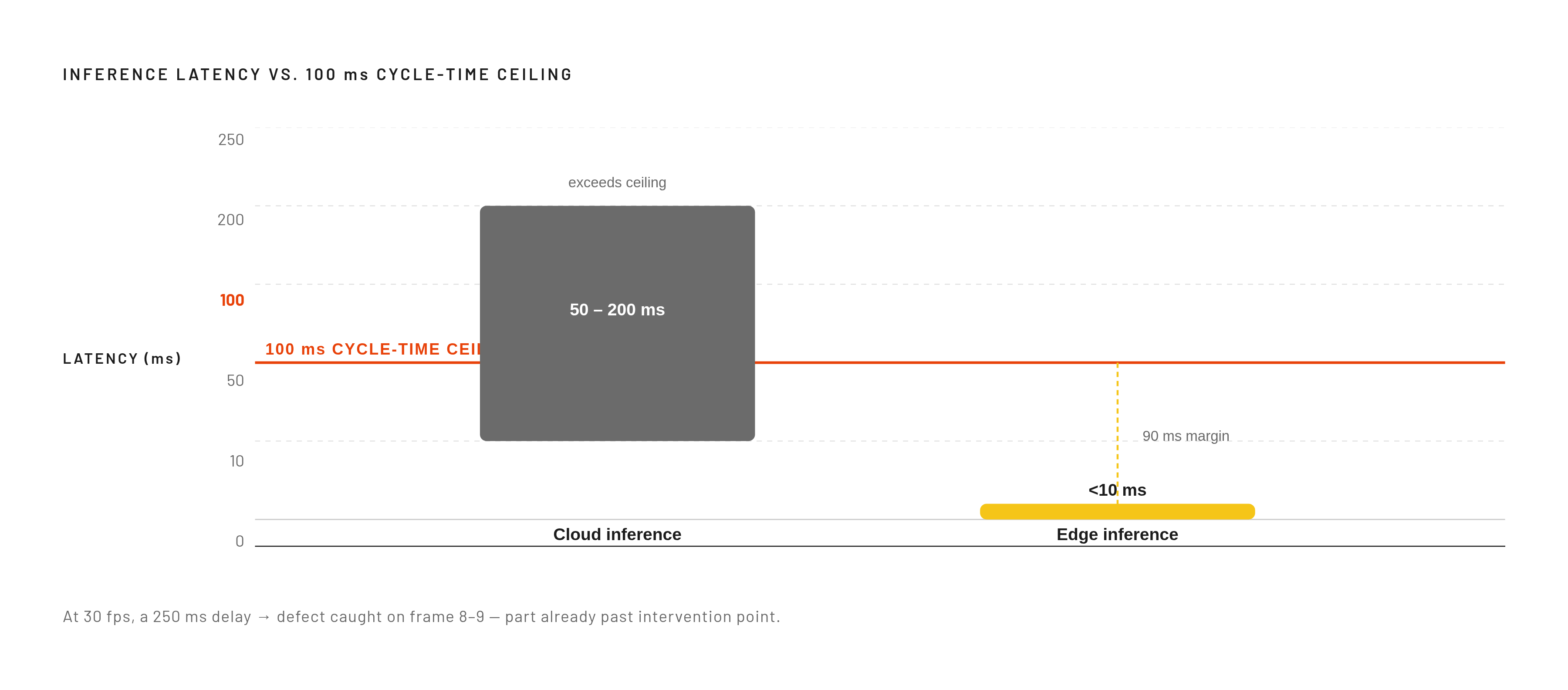
Start with the clock. Cloud inference carries a network round trip of roughly 50 to 200 milliseconds, and a fast production line can run a cycle time of about 100 milliseconds. Do the arithmetic and the problem appears: the round trip delay makes it impossible for the cloud, in a lot of these setups, to physically get an answer back before the next part shows up in the production cycle.
Edge inference avoids the round trip. Cutting the network hop gets responses in under 10 milliseconds, and a class of edge devices already lands under 100 milliseconds on vision tasks generally. That's not a marginal improvement, it's a different category of system.
The data itself is part of the bottleneck, separate from the round-trip delay. A single industrial camera throws off around 1.49 gigabits per second of raw video. Pushing that upstream to a cloud endpoint creates a bandwidth problem before latency even enters the conversation.
Picture what a 250-millisecond delay does inside a 30-frames-per-second pipeline. Instead of catching a defect on frame one, the system catches it on frame eight or nine. By then the part has already cleared the point where anyone could have pulled it, rerouted it, or stopped the line. The decision arrives, technically correct, and completely useless.
Connectivity and reliability as determinants of whether edge is optional or mandatory
Cloud inference works on one quiet assumption: a stable, fast internet connection is always there. Plenty of industrial sites can't make that promise.
BNSF Railway runs computer vision to inspect train wheels and track inventory across a network spanning more than 32,500 miles. Many of those yards don't have reliable broadband, and inspection results need to be available the moment they're generated, not after a retry over a spotty cell link. Running inference locally at each yard means the system keeps working even if the network fails that day.
Fletcher Sports offers a different flavor of the same lesson. Its Roboflow-powered camera systems at the US Open and Wimbledon process video at more than 20 frames per second per stream on edge devices installed at the venue, with no dependence on an internet connection to function. Tennis and rail freight have nothing in common operationally, but they share the same constraint: when the job has to happen in real time and in a specific physical place, you can't outsource the compute to somewhere else and hope the pipe holds.
Factories face the same geography constraints on connectivity. Remote sites, underground facilities, plants sitting inside enough electromagnetic interference to degrade wireless signals, all of it adds up to environments where a WAN outage cannot be allowed to mean a line stoppage. And the broader data picture backs this up: 75% of enterprise-managed data is now created and processed outside traditional data centers. Infrastructure spending has already followed that reality, not the other way around.
Data privacy and regulatory exposure that independently mandate local processing
Even with perfect latency and perfect connectivity, some data just shouldn't leave the building. Proprietary process parameters, product geometry, yield figures, supplier relationships, all of it rides along in raw video from a factory floor. Sending that footage to a hyperscale cloud endpoint creates a compliance and IP-exposure picture that looks nothing like keeping the same frame local.
The regulatory backdrop has only gotten less forgiving. The EU AI Act's risk categorizations, data-residency requirements, and sector rules specific to automotive, pharmaceutical, and defense manufacturing all intersect with the question of physical inference location. None of these frameworks care whether cloud inference was more convenient.
On-device processing sidesteps the question rather than answering it: the frame gets analyzed exactly where it was captured. No egress, no third-party data-processing agreement to read line by line, no clause to negotiate.
It gets messier with mixed workloads, though. The image itself might be entirely unremarkable, but the metadata riding alongside it, part IDs, batch numbers, yield rates, may fall squarely under regulation. An architecture built around this reality has to draw a clear line between what travels and what stays put, rather than treating "the data" as one undifferentiated blob.
How model complexity and compute requirements set the ceiling on what edge hardware can run
Not every inspection task needs a frontier model. A lot of classification and defect-detection work runs fine on compact, optimized models, and that's precisely the distinction that decides whether edge is even on the table for a given job.
The hardware tiers make the trade-offs concrete. At 7 to 15 watts, Jetson Orin Nano delivers 40 TOPS, entry-level edge inference. Jetson Orin NX steps up to 70 to 100 TOPS at 10 to 25 watts, enough for multi-camera setups at moderate resolution. Jetson AGX Orin tops out at 275 TOPS, drawing 15 to 60 watts, built around a 12-core ARM Cortex-A78AE CPU and a 2,048-core Ampere GPU, capable of running multiple high-resolution cameras and advanced perception stacks at once; it's supported in production through January 2032. A vendor's edge AI platform pushes this into plant-hardened territory, supporting up to four 4-lane MIPI or a comparable camera interconnect, and 12 POE ports, rated for operating temperatures between -25 and 50°C.
Model optimization narrows the gap between what a model wants and what edge silicon can give it. Compressing a full-precision model down to 50 to 100MB using TensorRT, ONNX, or OpenVINO cuts inference latency by a factor of two to four. Precision-reduction quantization can deliver meaningful latency gains with only modest accuracy trade-offs, depending on the model and task. Optimized detection models running on the Jetson Orin platform can achieve high frame rates suitable for demanding industrial inspection tasks. These numbers decide whether a given defect-detection model actually fits on an inexpensive board or needs a data center behind it.
The conditions under which cloud inference is the correct answer for industrial computer vision
Cloud wins outright in a handful of clear situations. Model retraining, drift monitoring, historical defect analysis, and audit logging don't run against a real-time clock, so the round-trip delay that kills cloud on the line simply doesn't matter here.
Cloud also wins when the model itself outgrows edge hardware, foundation models, vision-language models, large ensemble reasoning, zero-shot generalization on defect types nobody's trained for yet. A 275 TOPS ceiling is generous, but it is still a ceiling.
Bursty or occasional workloads favor cloud on cost grounds alone. Low or infrequent inference volume is cheaper billed by the request on a serverless API than amortized across dedicated edge hardware sitting mostly idle. Rapid prototyping fits the same logic: no hardware to provision, no deployment cycle to schedule around, just iteration on model architecture from a laptop.
The cost curve helps put a workload in context. Businesses running cloud-based computer vision at scale can face substantial monthly bills depending on volume and model size. Model drift adds a permanent tax on top of that: vision models lose accuracy as lighting, environment, and operational patterns shift over time, and retraining pipelines are best run on cloud infrastructure built for exactly that churn.
A practical production pattern threads this needle rather than picking a side outright: train in the cloud, deploy a compact optimized model to run locally at the edge, and hand results to the PLC over standard industrial protocols. Cloud stays the right home for training and the update cycle, even when the inference that matters happens at the edge.
When edge inference is the correct answer
Edge wins outright when the constraint is a hard real-time one, sub-10ms or sub-100ms decisions that a network round trip simply cannot deliver. It wins when connectivity is unreliable or uptime can't be allowed to depend on a WAN link staying up. It wins when raw video legally or contractually cannot leave the facility. And it wins when the model fits inside what's available on-device, currently a ceiling around 275 TOPS on the top-tier modules.
Volume matters just as much as latency. High, continuous inference volume runs at essentially zero marginal cost on edge hardware once it's purchased and deployed, against cloud billing that scales linearly with every request. For a lot of live products, lifetime inference spend can substantially exceed training spend, which flips the economics: at high continuous volume, edge hardware amortizes in its favor against per-second cloud billing. Keeping raw video and telemetry local also cuts bandwidth costs meaningfully, meaningfully against sending everything to the cloud for processing.
None of that arrives for free, though. A model optimization pipeline, TensorRT quantization, ONNX export, INT8 or FP16 compression, isn't optional polish, it's the only way to hit latency targets on hardware that fits inside plant power and thermal budgets. Hardware selection has to match the compute tier to the actual model and camera count; an Orin Nano and an AGX Orin are not interchangeable parts, whatever a spec sheet implies about "Jetson family" compatibility.
Industrial hardening is its own line item. Operating temperature range, ingress protection, vibration tolerance, all of it separates a dev-kit demo from a device that survives a foundry floor. ASRock's AGX Orin platform, rated for -25 to 50°C, is one example of what "industrial-grade" means once you get past the marketing language.
Update logistics deserve just as much planning as the initial deployment. Edge models need a managed pipeline for retraining and redeployment; skip that step and drift goes undetected until yield numbers start looking wrong for reasons nobody can immediately explain. And the inference result, however fast it's produced, still has to reach the PLC or SCADA system inside the cycle time, over OPC UA, Modbus TCP, or EtherNet/IP. A fast model that can't talk to the control system on time hasn't actually solved anything.
Hybrid architecture as the practical answer when neither pure edge nor pure cloud is sufficient
Hybrid is the correct architecture whenever the variables genuinely pull in opposite directions. It's the correct architecture whenever the variables genuinely pull in opposite directions, when latency demands a local decision but classifying a rare defect properly demands a model too large to fit on the device making that decision.
Four patterns occur repeatedly in how this actually gets built. Edge handles the real-time, high-frequency inference, while cloud fields the uncertain or high-risk cases escalated for a second look, an RF-DETR Large model in the cloud acting as an orchestration layer over edge-detected anomalies. Separately, edge runs a compact model like RF-DETR Nano day to day while cloud owns the retraining and update cycle, pushing improved weights back down to the fleet on a schedule. In a third pattern, metadata and event flags travel to the cloud while raw video stays put locally, which cuts bandwidth dramatically: a 720p camera running at 10 frames per second in H.265 produces roughly 486 gigabytes, not something you want crossing a WAN link routinely. And in mixed-sensitivity workloads, PII or other sensitive fields get stripped or anonymized before anything gets escalated to the cloud.
An ArXiv paper, "Quantifying Energy and Cost Benefits of Hybrid Edge Cloud: Analysis of Traditional and Agentic Workloads," found that under modeled conditions, hybrid edge-cloud architectures can cut energy use by as much as 75% and costs by more than 80% compared to pure cloud processing, for both traditional and agentic workloads. That's a case for treating pure cloud as the exception rather than the default once volume gets serious.
Tooling has started catching up to the pattern rather than lagging behind it. Roboflow Workflows lets a single workflow definition run across edge, gateway, and cloud targets from one specification, with an active learning loop where cloud predictions feed continuously back into retraining and updating the edge models. The architecture stopped being theoretical the moment the tooling made it something a team could actually ship, rather than stitch together by hand across three different vendors.
Sources
- Edge vs Cloud Inference: Where to Deploy Vision Models?
- Comparing Cloud and On-Device Inference for Computer Vision
- Edge vs. Cloud AI Vision Inspection: Why the Factory Floor Is Going Local
- Edge AI vs Cloud AI for Industrial Vision: When Each Makes Sense
- blog.roboflow.com
- legalnodes.com
- arxiv.org
- promwad.com